If you live in Grand Prairie, TX and the thought of sitting in a dental chair makes your pulse quicken, you’re far from alone. Studies suggest that somewhere between 9% and 20% of Americans avoid the dentist specifically because of anxiety or fear. The problem is that avoiding dental care doesn’t make dental problems go away; it makes them compound. Sedation dentistry exists to break that cycle, and understanding your options is the first step toward getting the care you need without the dread.
This guide walks through the sedation dentistry options available to Grand Prairie patients, how each one works, who they’re appropriate for, and what to expect before, during, and after your appointment.
What sedation dentistry actually is and what it isn’t
Sedation dentistry uses medication to help patients relax during dental procedures. It’s sometimes informally called “sleep dentistry,” but that label is misleading for most sedation types. Except for general anesthesia (which is rarely used in a dental office setting), you’re typically awake or semi-awake throughout the procedure. You can respond to your dentist, follow instructions, and breathe on your own. What changes is your perception: anxiety drops, time seems to pass quickly, and discomfort becomes much more manageable.
It’s also important to understand that sedation is separate from local anesthesia, the numbing injection at the treatment site. Most patients receiving sedation still get local anesthesia for pain control. The sedation handles the emotional and psychological side; the anesthetic handles the physical sensation.
The sedation options available near Grand Prairie
Grand Prairie sits in the heart of DFW, which means patients have access to a wide range of dental practices offering various sedation levels. The most common options you’ll encounter are nitrous oxide, oral conscious sedation, and IV sedation. Not every office offers every type, and the type that’s right for you depends on several factors.
Nitrous oxide (laughing gas)
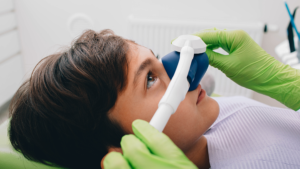
Nitrous oxide is the mildest form of dental sedation. You breathe a mixture of nitrous oxide and oxygen through a small mask placed over your nose. The effects begin within a few minutes: you feel lightheaded, warm, and less aware of the procedure happening around you.
The advantages are that it wears off quickly (usually within minutes of removing the mask), you can typically drive yourself home afterward, and it doesn’t require an empty stomach beforehand. The limitation is that it provides only mild relaxation for patients with moderate to severe dental anxiety; it may not be enough on its own.
Many dental offices in and around Grand Prairie offer nitrous oxide as a standard option. It’s often used for routine cleanings, fillings, and shorter procedures.
Oral conscious sedation
Oral conscious sedation involves taking a prescription anti-anxiety medication, typically a benzodiazepine like triazolam (Halcion) about an hour before your appointment. By the time you arrive at the office, you’re deeply relaxed. Most patients describe feeling drowsy and somewhat detached from what’s happening, though you remain conscious and can respond to your dentist.
This level of sedation is well-suited for patients who experience moderate dental anxiety, who have a strong gag reflex, or who need multiple procedures completed in a single longer appointment. One significant consideration: the effects last several hours after your procedure, so you’ll need a companion to drive you to and from the appointment.
Oral conscious sedation is offered by some dental practices near Grand Prairie, including 360 Dental Lounge in Mansfield, about 12 minutes south of Grand Prairie via Lake Ridge Parkway.
IV sedation
IV (intravenous) sedation delivers medication directly into your bloodstream through a small catheter, usually placed in your arm or hand. Because the medication is administered intravenously, the dentist can adjust the dosage in real time, increasing the level if you need deeper relaxation, or reducing it as the procedure wraps up.
IV sedation produces a deeper state of relaxation than oral sedation. Many patients have little or no memory of the procedure afterward. You remain conscious enough to respond to verbal cues, but you’re unlikely to recall sounds, sights, or sensations from the appointment.
This option is typically recommended for patients with severe dental anxiety or phobia, those undergoing lengthy or complex procedures (dental implant placement, full-mouth restorations, multiple extractions), and patients who haven’t responded well to lighter sedation methods in the past.
IV sedation requires additional training and credentials beyond what’s needed for nitrous oxide or oral sedation. Not every dental office offers it, and the ones that do generally have specific protocols: pre-procedure health screening, fasting requirements, continuous monitoring of vital signs during the procedure, and a post-procedure recovery period in the office before you’re released to your companion for the drive home.
How to decide which sedation level is right for you
The choice isn’t entirely up to you; your dentist will assess your medical history, current medications, the procedure you’re undergoing, and your anxiety level before recommending a sedation approach. But understanding the general framework can help you have a more informed conversation.
Mild anxiety with a routine procedure often pairs well with nitrous oxide. Moderate anxiety or a procedure that will take over an hour often calls for oral conscious sedation. Severe anxiety, a dental phobia that has kept you out of the chair for years, or a complex surgical procedure may warrant IV sedation.
Be honest with your dentist about your anxiety level. Many patients downplay their fear because they feel embarrassed, but dentists who offer sedation have heard it all, and accurate information helps them calibrate the right approach. There’s no judgment involved; the entire point is to make care accessible to people who otherwise avoid it.
What should Grand Prairie patients look for in a sedation dentistry provider?
When evaluating sedation dentistry options near Grand Prairie, a few factors matter beyond geography.
First, ask what types of sedation the practice offers. A practice that only provides nitrous oxide can’t escalate to a deeper sedation level if you need it. A practice that offers oral conscious sedation and IV sedation gives you and your dentist more flexibility.
Second, ask about the dentist’s training and credentials in sedation. IV sedation, in particular, requires specific continuing education and, in Texas, a sedation permit issued by the Texas State Board of Dental Examiners. This isn’t optional; it’s a legal requirement.
Third, ask about monitoring protocols. During IV sedation, your vital signs (blood pressure, heart rate, oxygen saturation) should be monitored continuously by trained staff. This is standard practice, but it’s worth confirming.
Finally, consider the overall environment. Sedation dentistry works best when the clinical setting itself is calming. A practice that has invested in comfort private treatment rooms, blankets, headphones, and low lighting demonstrates that patient anxiety is something they take seriously at every level, not just pharmacologically.
A note on location: why Grand Prairie patients sometimes look beyond city limits
Grand Prairie has a number of dental practices, several of which offer some form of sedation. However, patients looking specifically for IV sedation may find fewer options within Grand Prairie city limits. IV sedation requires a more specialized setup, and not every family dental practice invests in the equipment, training, and staffing it demands.
360 Dental Lounge, located in Mansfield at 3550 East Broad Street (about a 12-minute drive from most of Grand Prairie 75054 via Lake Ridge Parkway), offers both oral conscious sedation and IV sedation. The practice was designed around patient comfort; the office features aromatherapy, warm blankets, ceiling-mounted TVs, noise-canceling headphones, and sunglasses, complementing the pharmacological sedation with an environment built to reduce anxiety from the moment you walk in.
Dr. Rushabh Doshi, the practice’s lead dentist, holds advanced training in implantology and sedation protocols and has placed over 3,000 dental implants, many of them under IV sedation for patients who couldn’t have tolerated the procedure otherwise.
What to expect on the day of a sedation appointment
Regardless of which sedation type your dentist recommends, a few things are universal.
You’ll receive pre-appointment instructions. For oral sedation, this typically means taking your prescribed medication at a specific time before the appointment. For IV sedation, you’ll usually be asked to fast (no food or drink) for a set number of hours beforehand and to wear comfortable, loose-fitting clothing with sleeves that can be easily rolled up.
You’ll need a companion. For oral and IV sedation, you cannot drive yourself to or from the appointment. Arrange for a trusted adult to bring you and take you home.
The procedure itself will feel different than an unsedated visit. Time will seem to pass quickly. You may not remember much or anything about the procedure afterward, especially with IV sedation.
Afterward, you’ll spend some time recovering in the office before being released. Your dentist’s team will give you written post-procedure instructions covering what to eat, how to manage any residual grogginess, and when to resume normal activities.
Most patients are surprised by how straightforward the experience is. The anticipation is almost always worse than the reality, which, if you think about it, is the whole point.
FAQs (with FAQPage Schema Recommended)
Q: Is sedation dentistry safe for patients near Grand Prairie?
A: Sedation dentistry is considered safe when administered by a dentist with proper training and the required Texas sedation permit. Your dentist will review your medical history, current medications, and overall health before recommending a sedation type. During IV sedation, your vital signs are monitored continuously throughout the procedure.
Q: Will I be completely asleep during sedation dentistry?
A: With oral conscious sedation and IV sedation, you’ll be deeply relaxed but not fully unconscious. You can typically respond to your dentist’s verbal cues. Many patients feel as though they slept through the procedure because they have little memory of it afterward, but technically you remain in a semiconscious state.
Q: Can I drive myself home after sedation?
A: After nitrous oxide (laughing gas), most patients can drive themselves home because the effects wear off within minutes. After oral conscious sedation or IV sedation, you cannot drive; the effects last several hours, and you’ll need a companion to take you home.
Q: How long does dental sedation last?
A: Nitrous oxide wears off in about 5 minutes after the mask is removed. Oral sedation effects can last 4 to 8 hours after the procedure. IV sedation grogginess typically subsides within a few hours, though you may feel mildly drowsy for the rest of the day.
Q: Does insurance cover sedation dentistry near Grand Prairie?
A: Coverage varies by plan and by the reason for sedation. Some dental insurance plans cover sedation when it’s deemed medically necessary, for example, for patients with documented dental phobia or for certain surgical procedures. Contact your insurance provider and your dentist’s office to verify coverage before your appointment.
Q: What dental procedures commonly use sedation?
A: Common procedures performed under sedation include dental implant placement, wisdom tooth extraction, root canals, multiple fillings in a single visit, full-mouth restorations, and any procedure for patients with severe dental anxiety or a strong gag reflex.
Q: How do I find a dentist near Grand Prairie who offers IV sedation?
A: Look for a dental practice that specifically lists IV sedation (not just nitrous oxide) on their website, and verify that the dentist holds a Texas sedation permit. 360 Dental Lounge in Mansfield, about 12 minutes from Grand Prairie, offers both oral conscious sedation and IV sedation.
Q: What’s the difference between sedation and general anesthesia?
A: Sedation keeps you in a relaxed, semi-aware state where you can still breathe on your own and respond to your dentist. General anesthesia renders you completely unconscious and requires an anesthesiologist. General anesthesia is rarely used in dental offices; it’s typically reserved for hospital-based oral surgery.
If you’re a Grand Prairie resident considering sedation for your next dental procedure, 360 Dental Lounge in nearby Mansfield offers both oral conscious sedation and IV sedation with a team trained to match the right level to your needs. Call (682) 888-0488 or visit 360dentallounge.com to schedule a consultation.